The Indian Army is the land-based branch of the Indian Armed Forces. It is responsible for defending India’s borders, maintaining peace and order within the country, and supporting civil authorities during emergencies such as natural disasters.
From the icy heights of Ladakh to the dense jungles of the Northeast and the deserts of Rajasthan, the Army’s operational efficiency depends heavily on its command structure.
The Indian Army Commands are the highest field formations of the Indian Army, responsible for operational, administrative, and logistical control over designated geographical areas or functional domains.
Each command is headed by a General Officer Commanding-in-Chief (GOC-in-C), typically of the rank of Lieutenant General. These commands function under the overall authority of the Chief of the Army Staff (COAS) at Army Headquarters in New Delhi.
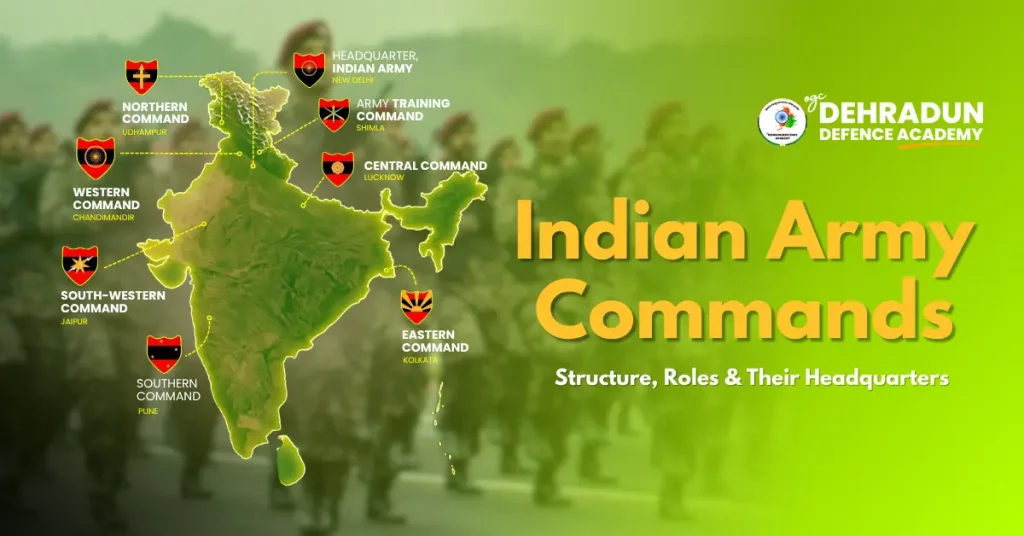
India’s size and strategic environment demand decentralised military control. The Indian Army is organised into seven operational commands and one training command, each tailored to specific strategic requirements.
This ensures faster decision-making, terrain-specific strategy, and better coordination during war and peace.
Today, the Indian Army operates 7 Commands:
6 Operational (geographical), 1 Functional (training)
- Northern Command
- Western Command
- Eastern Command
- Southern Command
- Central Command
- South Western Command
- Army Training Command (ARTRAC)
Northern Command
Headquarters: Udhampur, Jammu & Kashmir
The Northern Command is responsible for India’s most sensitive operational theatre. It oversees military operations along the Line of Control (LoC) with Pakistan in Jammu & Kashmir and the Line of Actual Control (LAC) in eastern Ladakh with China.
This command manages sustained high-altitude deployments, counter-infiltration operations, and counter-terrorism tasks within Jammu & Kashmir. It controls multiple corps formations tasked with both conventional defence and internal security responsibilities. Due to the intensity and continuity of operations, it is widely regarded as the most operationally engaged command of the Indian Army.
Western Command
Headquarters: Chandimandir, Haryana
The Western Command is responsible for the defence of the plains sector along the India–Pakistan border, particularly in Punjab and adjoining areas. It is structured for high-intensity conventional warfare, with a strong emphasis on mechanised and armoured operations.
The command maintains formations capable of rapid mobilisation and offensive-defensive operations in plains terrain. It has historically played a central role in major conflicts on the western front and remains a key component of India’s conventional deterrence posture.
Eastern Command
Headquarters: Kolkata, West Bengal
The Eastern Command is tasked with overseeing India’s eastern and northeastern regions. Its operational responsibilities include the LAC with China in Arunachal Pradesh and international borders with Myanmar, Bangladesh, and Bhutan.
This command specialises in mountain warfare and conducts counter-insurgency operations in the Northeast. It maintains multiple corps formations adapted to high-altitude and jungle terrain. The command also supports civil authorities in internal security situations when required.
Southern Command
Headquarters: Pune, Maharashtra
The Southern Command covers peninsular India, including Maharashtra, Karnataka, Tamil Nadu, Kerala, and parts of central India. Unlike border-focused commands, it does not have a direct responsibility for active international borders.
Its primary role is administrative, logistical, and training support, including maintenance of reserves, infrastructure management, and coordination of training establishments within its area. It also provides depth support to other commands when required.
Central Command
Headquarters: Lucknow, Uttar Pradesh
The Central Command functions as a strategic reserve and reinforcement command. It supports both the Northern and Eastern Commands and maintains responsibility for certain sectors along the central portion of the LAC with China.
Its formations are structured to provide operational depth and flexibility, enabling rapid redeployment to active theatres. The command also contributes to disaster relief and internal security support when called upon.
South Western Command
Headquarters: Jaipur, Rajasthan
The South Western Command is responsible for operations in the desert and semi-desert sectors along the India–Pakistan border in Rajasthan.
It is specifically configured for desert warfare, with a strong concentration of armoured and mechanised formations. The command conducts large-scale exercises to maintain readiness for mobile, high-speed operations in arid terrain and plays a crucial role in India’s western front strategy.
Army Training Command (ARTRAC)
Headquarters: Shimla, Himachal Pradesh
The Army Training Command (ARTRAC) is the Indian Army’s nodal authority for training, doctrine, and professional development.
It is responsible for formulating training policies, developing military doctrines, evaluating training standards, and guiding modernisation concepts. ARTRAC ensures that the Army’s training systems remain aligned with evolving operational requirements, technological advancements, and future warfare concepts.
Structure and Operational Framework
Each command controls multiple corps, which are the primary operational formations of the Indian Army. Corps are further divided into divisions, brigades, and battalions. These formations are supported by artillery, engineers, signals, logistics, and specialised units.
Commands operate in coordination with other services of the Indian Armed Forces, particularly in joint operational planning and integrated defence scenarios.
The Indian Army Commands form the backbone of India’s land-based military structure. Designed to address diverse operational challenges across varied terrains, they ensure that the Army remains responsive, flexible, and capable of defending national interests in both conventional and unconventional scenarios
Read Also:
Ranks in Indian Army – Detailed Guide to Ranks & Insignia