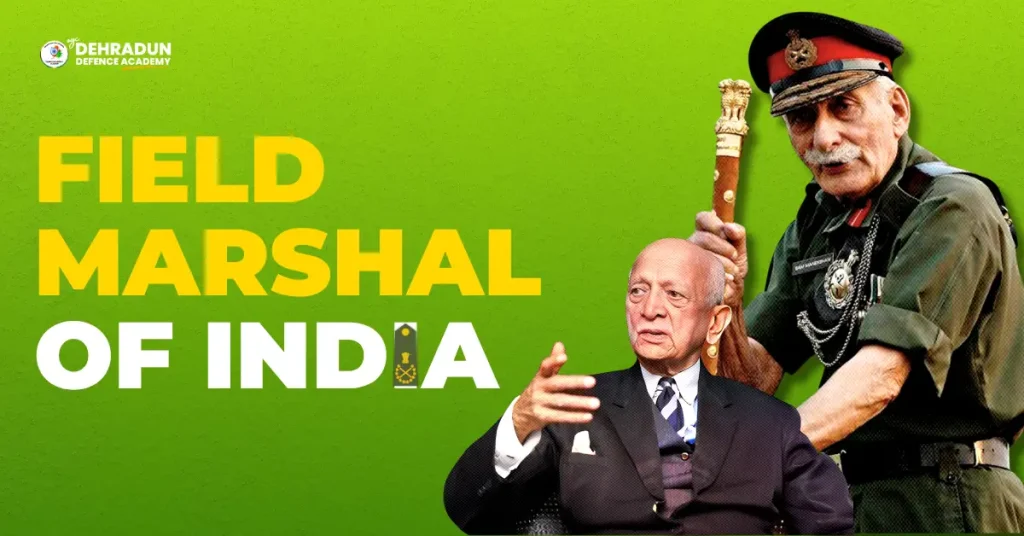
Field Marshal is the highest rank in the Indian Army. It is a five-star rank and is placed above the rank of General. It is a very rare honour. In the entire history of independent India, only two officers have ever held this rank. They are Field Marshal Sam Manekshaw and Field Marshal K.M. Cariappa. The rank is mostly ceremonial. It is given to recognise exceptional service to the nation.
This article explains the rank of Field Marshal in simple terms. It covers what the rank means, the two officers who have held it, and the related five-star ranks of the other armed forces. The article is useful for NDA, CDS, AFCAT and UPSC aspirants, as well as general readers.
What is the Rank of Field Marshal?
In the army, ranks show the level of command and seniority of an officer. A normal officer can rise up to the rank of General, who is the Chief of the Army Staff. Field Marshal is one rank above a General. It is a five-star rank, while a General holds a four-star rank.
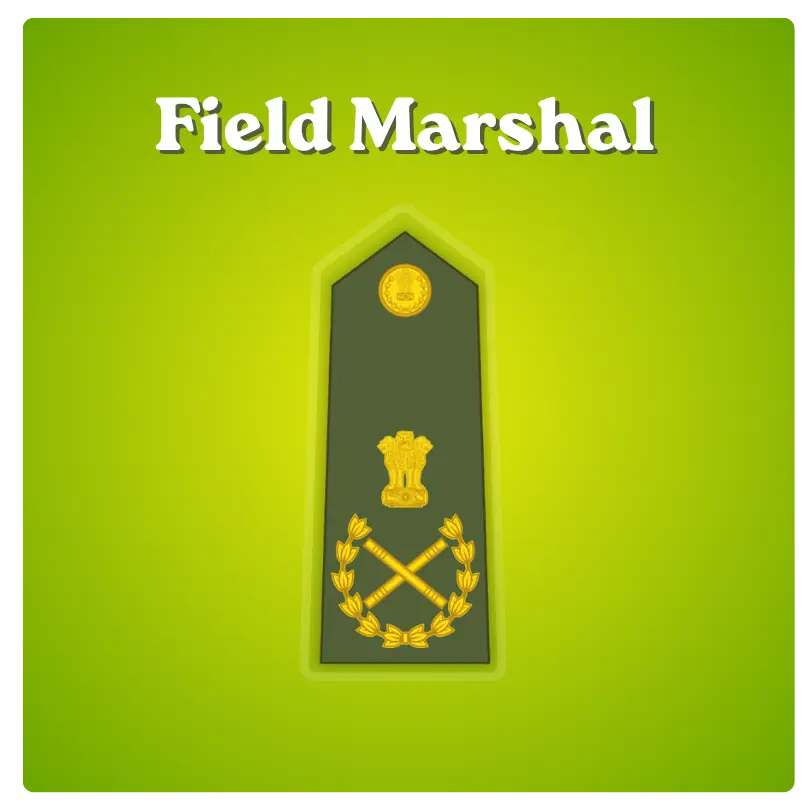
The main features of the rank are given below.
| Feature | Detail |
| Service | Indian Army |
| Star rank | Five-star (highest) |
| Nature | Ceremonial and honorary |
| Tenure | Held for life |
| Retirement | A Field Marshal never formally retires |
| Total holders | Only two officers in Indian history |
A Field Marshal holds the rank for life. Unlike other officers, a Field Marshal does not fully retire. He is considered a serving officer of the army until his death. He continues to wear the uniform and is entitled to the full pay of the rank for life. Because the rank is so senior and so rare, it is given only in special cases of outstanding leadership and national service.
Full Officer Rank Hierarchy of the Indian Army
To understand where the Field Marshal stands, it helps to see the full ladder of officer ranks. The table below lists the commissioned officer ranks of the Indian Army from the lowest to the highest, along with their star level.
- Lieutenant
- Captain
- Major
- Lieutenant Colonel
- Colonel
- Brigadier
- Major General
- Lieutenant General
- General (Chief of the Army Staff)
- Field Marshal
General vs Field Marshal: A Quick Comparison
Many aspirants get confused between a General and a Field Marshal. Both are very senior, but they are not the same. The table below compares the two ranks side by side.
| Point of Difference | General | Field Marshal |
| Star level | Four stars | Five stars |
| Position | Highest rank in active service | Highest rank in the army |
| Role | Serves as Chief of the Army Staff | Ceremonial and honorary |
| Active command | Holds active operational command | Does not hold active command |
| Tenure | Fixed tenure, then retires | Held for life |
| Retirement | Retires at the end of tenure | Never formally retires |
| How attained | Through normal promotion | Specially conferred by the Government |
| How common | Many officers reach this rank | Only two officers in history |
The Field Marshals of India
India has had only two Field Marshals. Both belonged to the Indian Army. The table below gives a quick summary.
| Field Marshal | Rank Conferred | Key Distinction | Lifespan |
| Sam Manekshaw | 1 January 1973 | First Field Marshal of India; led the 1971 war | 1914–2008 |
| K. M. Cariappa | 15 January 1986 | First Indian Commander-in-Chief of the Indian Army | 1899–1993 |
Field Marshal Sam Manekshaw
Field Marshal Sam Hormusji Framji Jamshedji Manekshaw was the first Field Marshal of India. He was popularly known as “Sam Bahadur,” which means “Sam the Brave.” He was born on 3 April 1914 in Amritsar, in a Parsi family. He died on 27 June 2008 in Wellington, Tamil Nadu.
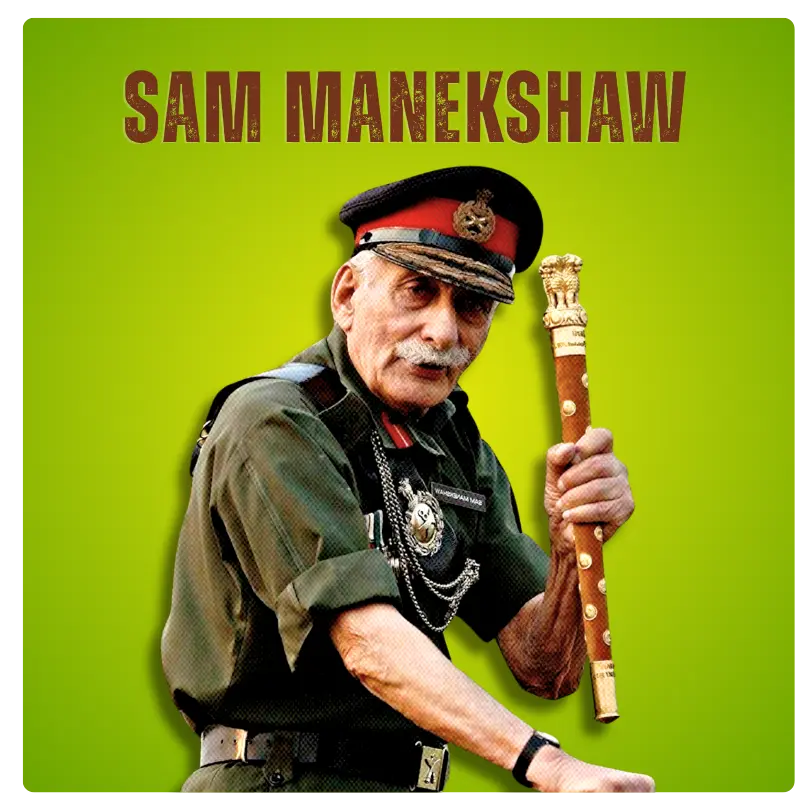
Manekshaw was among the first batch of cadets of the Indian Military Academy (IMA) in Dehradun in 1932. He was commissioned into the British Indian Army in 1934. During the Second World War, he fought against the Japanese in Burma. At the Battle of Sittang Bridge in 1942, he showed great courage and was badly wounded. For his bravery, he was awarded the Military Cross.
Manekshaw became the seventh Chief of the Army Staff in 1969. His most famous role came during the 1971 India-Pakistan War. As the Army Chief, he led the Indian forces to a decisive victory. The war lasted only 13 days. It ended with the surrender of about 93,000 Pakistani troops and the creation of the new nation of Bangladesh. This victory is remembered as one of the greatest in Indian military history.
For his service, he received the Padma Bhushan in 1968 and the Padma Vibhushan in 1972. On 1 January 1973, he was promoted to the rank of Field Marshal. He became the first Indian Army officer to receive this honour. The formal ceremony was held at Rashtrapati Bhavan. He retired from active service on 15 January 1973, a day now celebrated as Army Day.
Manekshaw is remembered for his sharp wit, his honesty, and his courage to stand up to political pressure. He remains one of the most respected soldiers in Indian history.
Field Marshal K. M. Cariappa
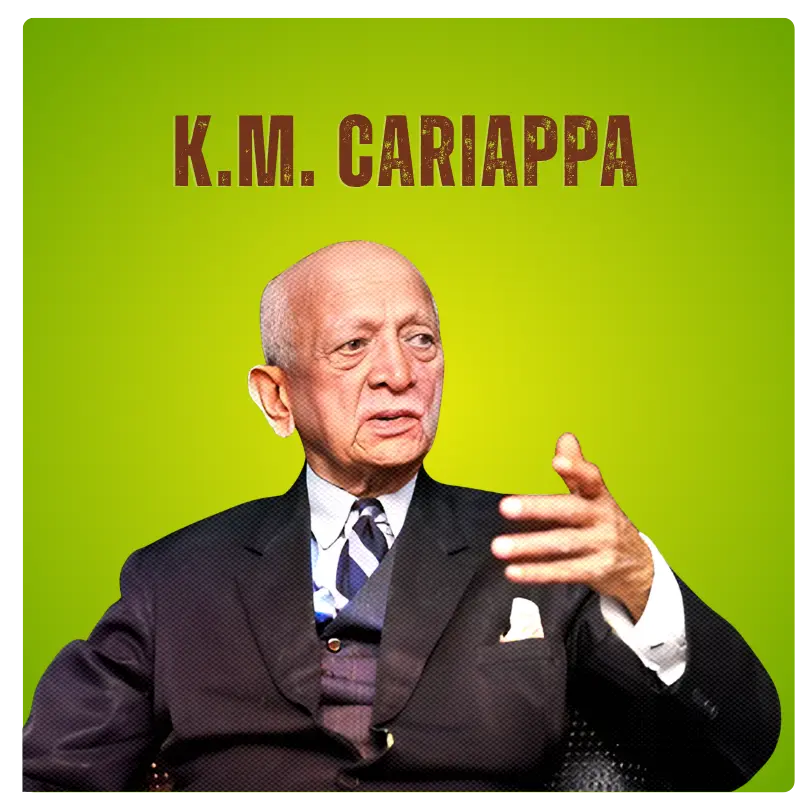
Field Marshal Kodandera Madappa Cariappa was the second Field Marshal of India. He was popularly known as “Kipper.” He was born on 28 January 1899 in Shanivarsanthe, in the Kodagu (Coorg) region of present-day Karnataka. He belonged to a Kodava family. He died on 15 May 1993 in Bengaluru.
Cariappa joined the British Indian Army in 1919. He was among the first group of Indians selected to become officers. He served in the Middle East and in Burma during the Second World War. In 1942, he became the first Indian officer to command a unit. For his wartime service, he was awarded the Order of the British Empire (OBE).
During the Partition of India in 1947, Cariappa was given the difficult task of dividing the army between India and Pakistan. He carried out this task in a fair and orderly manner. On 15 January 1949, he made history by becoming the first Indian Commander-in-Chief of the Indian Army. He took over from the last British commander, General Sir Roy Bucher. This day, 15 January, is now celebrated every year as Army Day.
Cariappa led the Indian forces on the Western Front during the 1947–48 India-Pakistan War. He retired from the army in 1953. After that, he served as India’s High Commissioner to Australia and New Zealand. He was also honoured by the United States with the Legion of Merit by President Harry S. Truman.
In recognition of his services, the Government of India conferred the rank of Field Marshal on Cariappa on 15 January 1986. A special investiture ceremony was held at Rashtrapati Bhavan on 28 April 1986. This honour came 33 years after his retirement. He was known for his discipline, his honesty, and his belief that the army should remain apolitical.
Five-Star Ranks of the Indian Armed Forces
Each of the three armed forces has its own equivalent of the five-star rank. The army rank is Field Marshal. The table below shows the five-star ranks of all three services and how rare they are.
| Service | Five-Star Rank | Officers Who Held It |
| Indian Army | Field Marshal | Two – Sam Manekshaw and K. M. Cariappa |
| Indian Air Force | Marshal of the Indian Air Force | One – Arjan Singh (conferred in 2002) |
| Indian Navy | Admiral of the Fleet | None so far |
As the table shows, the five-star rank is extremely rare in India. The Indian Air Force has had only one such officer, Marshal of the Indian Air Force Arjan Singh. The Indian Navy has never conferred its five-star rank, Admiral of the Fleet, on any officer.
Why the Rank is Special
The rank of Field Marshal is special for many reasons. It is the highest rank an army officer can reach. It is given very rarely, and only for exceptional service. A Field Marshal holds the rank for life and never fully retires. Both Indian Field Marshals are linked to great moments in Indian military history. Manekshaw is linked to the 1971 victory and the birth of Bangladesh. Cariappa is linked to the first Indian command of the army after Independence. Both men are seen as role models of leadership, discipline and service.
Key Points for Defence Aspirants
For exams like the NDA, CDS and AFCAT, and for the SSB interview, the following facts about the Field Marshal rank are the most important to remember.
- Field Marshal is the highest rank in the Indian Army. It is a five-star rank.
- It is a ceremonial and honorary rank. It is held for life, and the officer never formally retires.
- Only two officers in India have held this rank.
- Sam Manekshaw was the first Field Marshal of India. He was conferred the rank on 1 January 1973.
- Manekshaw was the Chief of the Army Staff during the 1971 India-Pakistan War. The war led to the creation of Bangladesh.
- K. M. Cariappa was the second Field Marshal of India. He was conferred the rank on 15 January 1986.
- Cariappa was the first Indian Commander-in-Chief of the Indian Army, on 15 January 1949.
- 15 January is celebrated every year as Army Day, marking the day Cariappa took charge.
- The Indian Air Force has only one five-star officer, Marshal of the Indian Air Force Arjan Singh (2002).
- The Indian Navy has never conferred its five-star rank, Admiral of the Fleet.
Frequently Asked Questions (FAQs)
Q1. Who was the first Field Marshal of India?
Sam Manekshaw was the first Field Marshal of India. He was conferred the rank on 1 January 1973.
Q2. Who was the second Field Marshal of India?
K. M. Cariappa was the second Field Marshal of India. He was conferred the rank on 15 January 1986.
Q3. How many Field Marshals has India had?
India has had only two Field Marshals so far — Sam Manekshaw and K. M. Cariappa. Both belonged to the Indian Army.
Q4. Is Field Marshal higher than General?
Yes. Field Marshal is a five-star rank, while a General is a four-star rank. Field Marshal is the highest rank in the Indian Army.
Q5. Does a Field Marshal ever retire?
No. A Field Marshal holds the rank for life. He is treated as a serving officer of the army until his death and never formally retires.
Q6. Why is the rank of Field Marshal given?
It is a ceremonial and honorary rank. It is given by the Government of India to recognise exceptional leadership and outstanding service to the nation.
Q7. What is the Field Marshal rank called in the Air Force and Navy?
In the Indian Air Force, the equivalent five-star rank is Marshal of the Indian Air Force. In the Indian Navy, it is Admiral of the Fleet.
Q8. Who is the only Marshal of the Indian Air Force?
Arjan Singh is the only officer to hold the five-star rank of Marshal of the Indian Air Force. He was conferred the rank in 2002.
Q9. Why is 15 January celebrated as Army Day?
On 15 January 1949, K. M. Cariappa became the first Indian Commander-in-Chief of the Indian Army. This day is celebrated every year as Army Day.
Q10. Which war is linked to Field Marshal Sam Manekshaw?
Manekshaw is linked to the 1971 India-Pakistan War. As the Army Chief, he led India to victory, which resulted in the creation of Bangladesh.