For many young Indians, becoming an officer in the Army, Navy or Air Force is a proud dream. One of the best and earliest ways to reach this goal is the NDA exam. School students can apply for it right after Class 12. But before starting preparation, every aspirant should clearly understand one basic question: what is the NDA exam?
In this article we explain the NDA exam in simple language. The information here is based on the latest official details provided by the UPSC for the NDA and NA Exam.
What is the NDA Exam?
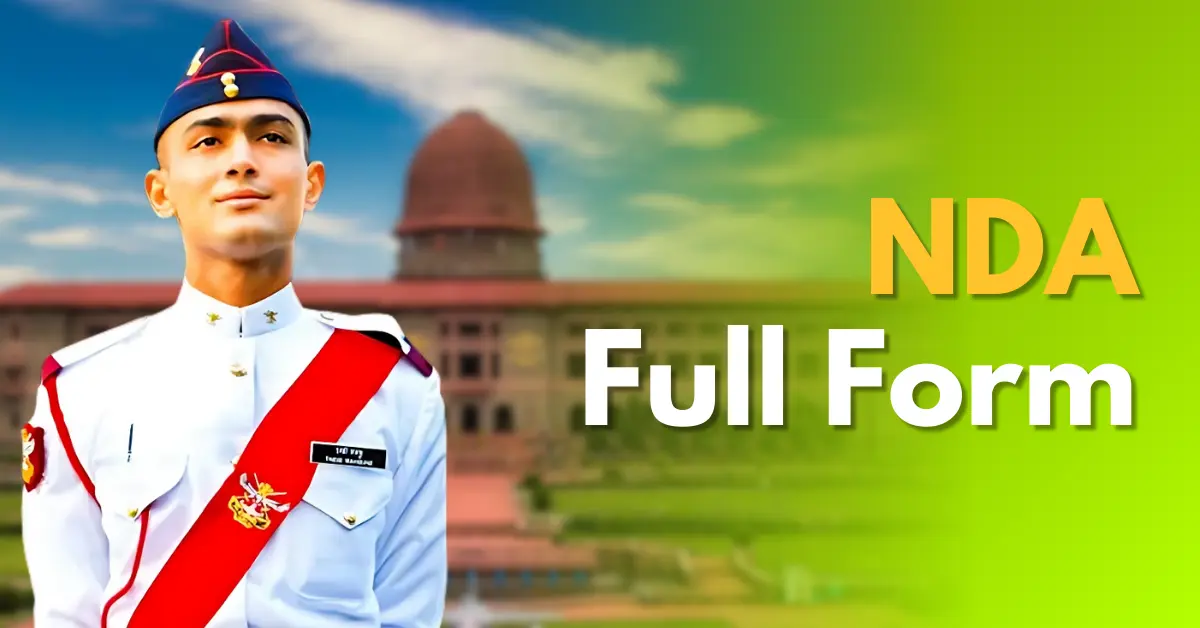
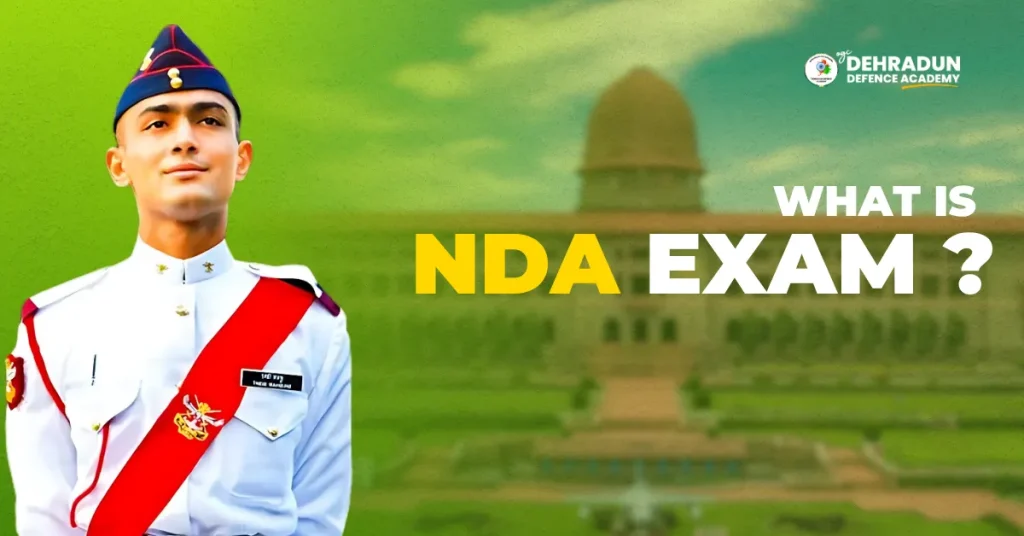
NDA stands for National Defence Academy. The NDA exam is officially called the National Defence Academy and Naval Academy Examination. It is a national-level entrance exam. Through it, candidates are selected for training to become officers in the Indian Armed Forces – Army, Navy and Air Force. The exam also selects candidates for the 10+2 Cadet Entry Scheme at the Indian Naval Academy.
The National Defence Academy itself is a famous tri-service training institution located at Khadakwasla, near Pune. It is the place where future officers of all three services train together.
Who Conducts the NDA Exam?
The NDA exam is conducted by the Union Public Service Commission (UPSC) twice every year, known as NDA-I and NDA-II. The eligibility conditions and the syllabus are the same for both; only the dates and the number of vacancies change.
Important Dates (NDA-II 2026)
The table below shows the key dates for NDA-II 2026, taken from the official notification.
| Event | Date |
| Date of notification | 20 May 2026 |
| Last date to apply | 9 June 2026 (up to 6:00 PM) |
| Date of written examination | 13 September 2026 |
| Course commencement | 1 July 2027 |
Candidates must apply online only, through the UPSC portal at upsconline.nic.in.
The Three Wings and the Naval Academy Entry
Through the NDA exam, a candidate can join one of the following, based on merit, choice and eligibility.
| Wing / Entry | Future Service |
| Army Wing of the NDA | Officer in the Indian Army |
| Naval Wing of the NDA | Officer in the Indian Navy |
| Air Force Wing of the NDA | Officer in the Indian Air Force |
| 10+2 Cadet Entry Scheme (Indian Naval Academy) | Officer in the Executive Branch of the Navy |
For NDA-II 2026, the total number of vacancies is about 394.
Who Can Apply? (Eligibility in Brief)
A candidate must meet a few basic conditions to apply for the NDA exam. The main ones are given below.
- Nationality: The candidate must be a citizen of India, or a subject of Nepal, or a person of Indian origin from certain specified countries who has settled in India.
- Gender and marital status: Both male and female candidates can apply, but they must be unmarried.
- Age: For NDA-II 2026, the candidate must be born between 1 January 2008 and 1 January 2011.
- Educational qualification: For the Army Wing, a Class 12 pass in any stream is enough. For the Air Force Wing, Naval Wing and the Naval Academy entry, the candidate must have passed Class 12 with Physics, Chemistry and Mathematics.
- Physical fitness: The candidate must be physically and mentally fit as per the prescribed medical standards.
Students who are appearing in Class 12 can also apply. Class 11 students are not eligible.
This is only a quick summary. For the complete details on nationality, age limit, marital status, educational qualification, physical standards and fee, read our detailed guide on NDA Exam Eligibility 2026.
NDA Exam Pattern and Syllabus (In Brief)
The NDA selection has two main parts: a written examination and the SSB interview. The written exam has two papers, as shown below.
| Paper | Subject | Maximum Marks | Duration |
| Paper I | Mathematics | 300 | 2½ hours |
| Paper II | General Ability Test | 600 | 2½ hours |
| Written Total | 900 | ||
| SSB Test / Interview | 900 |
Both papers contain objective type (multiple choice) questions only. The two papers are described below:
- Mathematics (Paper I): Based mainly on the Class 11 and Class 12 level. It covers topics such as Algebra, Matrices and Determinants, Trigonometry, Analytical Geometry, Differential and Integral Calculus, Vector Algebra, and Statistics and Probability.
- General Ability Test (Paper II): Divided into two parts — English (200 marks) and General Knowledge (400 marks). The General Knowledge part covers Physics, Chemistry, General Science, History, Geography and Current Events.
Negative Marking
There is negative marking in both written papers. The rules are simple:
- For every wrong answer, one-third (0.33) of the marks for that question is deducted.
- If a candidate marks more than one answer, it is treated as wrong, even if one of them is correct.
- If a question is left blank, there is no penalty.
For the full topic-wise breakdown, marks and section-wise weightage, see our complete guide on the NDA Exam Syllabus 2026.
NDA Selection Process: Step by Step
The full selection process has clear stages. A candidate must clear each one.
- Online Application – Apply on the UPSC website within the given dates.
- Written Examination – Appear for the Mathematics and General Ability Test papers (900 marks).
- SSB Interview – Candidates who clear the written exam are called for the Services Selection Board (SSB) interview (900 marks). This is a five-day, two-stage process. Stage I has the Officer Intelligence Rating test and the Picture Perception and Description Test. Stage II has the Interview, Group Testing Officer tasks, Psychology tests and the Conference.
- CPSS (for Air Force Flying Branch) – Candidates choosing the Air Force Flying Branch must also clear the Computerised Pilot Selection System. This test is given only once in a lifetime.
- Medical Examination – Candidates recommended by the SSB undergo a medical test, and only those found fit are admitted.
- Final Merit List and Joining – A combined merit list is prepared from the written and SSB marks, and selected candidates receive a joining letter.
To know the exact eligibility rules behind each stage, the NDA Exam Eligibility 2026 guide explains them in full.
Training After the NDA Exam
Selected candidates are first trained for three years at the National Defence Academy, Khadakwasla, Pune. The first two and a half years of training are common to cadets of all three wings. On passing out, cadets are awarded a degree from Jawaharlal Nehru University (JNU) – a B.Sc., B.Sc. (Computer) or B.A. for Army cadets, and a B.Tech for Naval and Air Force cadets.
After the NDA, cadets move to their service-specific academies for further training:
- Army cadets go to the Indian Military Academy (IMA), Dehradun.
- Naval cadets go to the Indian Naval Academy, Ezhimala.
- Air Force cadets go to the Air Force Academy, Hyderabad (and to the Air Force Technical College, Bengaluru, for the technical stream).
On successful completion, officers are commissioned — as a Lieutenant in the Army, a Sub-Lieutenant in the Navy, and a Flying Officer in the Air Force. To understand how an officer rises from these ranks, see our articles on the Indian Army Ranks and Insignia and the highest rank of all, the Field Marshal of India.
Frequently Asked Questions (FAQs)
Q1. What is the full form of NDA?
A. NDA stands for National Defence Academy. The exam is officially called the National Defence Academy and Naval Academy Examination.
Q2. Who conducts the NDA exam?
A. The NDA exam is conducted by the Union Public Service Commission (UPSC), twice a year.
Q3. After Class 12, can I directly apply for the NDA?
A. Yes. Class 12 pass candidates, and those appearing in Class 12, can apply if they meet the age and other conditions.
Q4. Which services can I join through the NDA?
A. You can join the Army, Navy or Air Force wing of the NDA, or the 10+2 Cadet Entry Scheme of the Indian Naval Academy.
Q5. How many stages are there in the NDA selection?
A. There are two main stages – a written examination (900 marks) and the SSB interview (900 marks). The Air Force Flying Branch also needs the CPSS test, followed by a medical examination.
Q6. Where is the NDA located?
A. The National Defence Academy is located at Khadakwasla, near Pune, Maharashtra.
Q7. How long is the NDA training?
A. Training is for three years at the NDA, after which cadets move to their service academies, such as the IMA in Dehradun, for further training.
Q8. Can girls apply for the NDA exam?
A. Yes. Unmarried female candidates are eligible, and separate vacancies are notified for women.
Q9. What is the difference between NDA-I and NDA-II?
A. Both are the same exam held at different times of the year. The eligibility and syllabus are the same; only the dates and vacancies differ.
Q10. What degree do NDA cadets get?
A. On passing out, cadets are awarded a degree from Jawaharlal Nehru University – a B.Sc., B.Sc. (Computer) or B.A. for the Army, and a B.Tech for the Navy and Air Force.