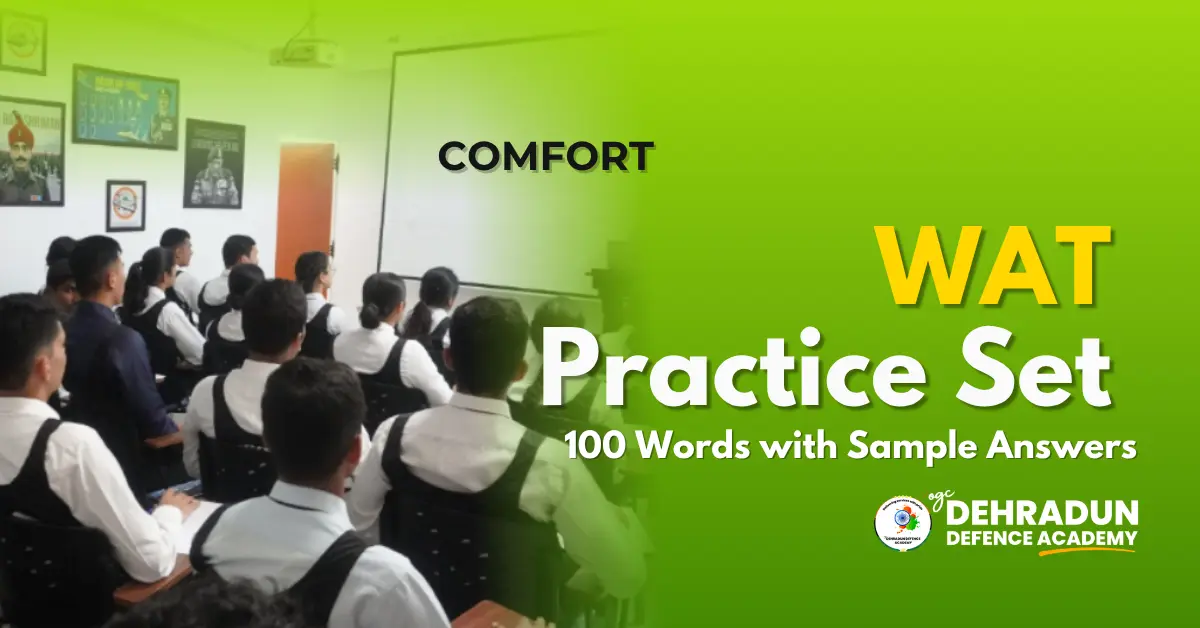
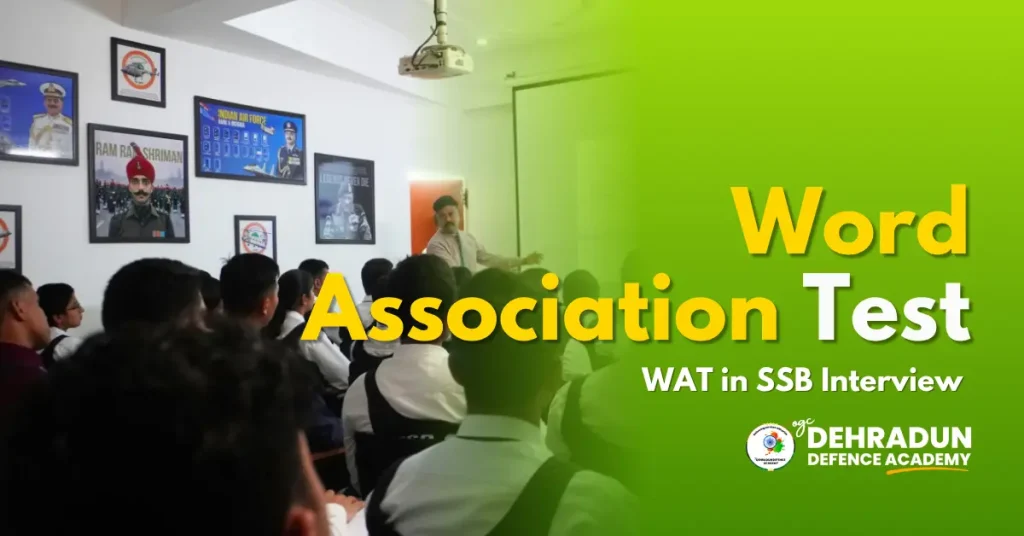
The Word Association Test (WAT) is a psychological test used in the Services Selection Board (SSB) to assess how you think, feel, and react under pressure. In this test, you are shown a series of words, one after the other, and for each word you must write one short, meaningful sentence within a strict time limit.
The aim is not to test your English but to understand your personality and subconscious thought process. Every word you see acts like a mirror – what you write reflects your values, habits, and officer-like qualities.
- Total words: 60
- Time per word: ~15 seconds
- Response style: One clear, action-oriented sentence
- Language: English (simple, not decorative)
The WAT is one of four psychological tests conducted by the Psychologist during the assessment:
- TAT – Thematic Apperception Test
- WAT – Word Association Test
- SRT – Situation Reaction Test
- SD – Self-Description
Your WAT performance is not judged alone – it is read in combination with the other three tests. The assessors look for consistency across all four.
The short time is not meant to trap you. It forces you to write your first, natural thought Before overthinking or any manipulation. This way, psychologists can study your subconscious personality traits rather than rehearsed answers.
- You may skip up to 3–4 words, as more could be seen by psychologists as avoidance of situation. If the meaning is unknown, write ‘meaning not known’ in the allotted space.
- If you can’t finish a sentence, leave it incomplete – don’t panic.
- Remember: It’s about pattern of thinking, not one word or one line.
Golden Writing Rules for WAT in SSB
- Focus on behaviour and action, not dictionary definitions.
- Wrong: Discipline is following rules.
- Right: Discipline guides actions even without supervision.
- Wrong: Discipline is following rules.
- Write in active voice, present tense.
- Example: Leaders inspire confidence.
- Example: Leaders inspire confidence.
- Turn negative words into constructive sentences.
- Example: Fear is reduced by training and preparation.
- Example: Fear is reduced by training and preparation.
- Keep it short – 10–14 words are enough.
- Avoid extreme words (revenge, hate, kill), self-pity, or helplessness.
- Never memorize and reproduce stock lines – it looks artificial.
Myths vs Facts
- Myth: Good English = Good WAT.
Fact: Simple, clear English works best. - Myth: Definitions are enough.
Fact: Assessors want attitudes, actions, values. - Myth: Only one correct answer exists.
Fact: Many constructive answers are possible. - Myth: Long sentences look smarter.
Fact: Crisp, action-focused sentences show clarity. - Myth: Negative words must be skipped.
Fact: They should be handled positively.
Examples: Weak vs Better
Word: Failure
- Weak: Failure is bad.
- Better: Failure motivates preparation for success.
Word: Fear
- Weak: Fear is weakness.
- Better: Training helps overcome fear.
Word: Teamwork
- Weak: Teamwork is important.
- Better: Teamwork achieves goals through unity and discipline.
Word: Discipline
- Weak: Discipline means rules.
- Better: Discipline ensures right action even without supervision.
Nature of Words Shown in WAT
The words are simple, everyday words – not tough vocabulary. They are chosen to bring out your thoughts across different areas of life.
Types of words you may see:
- Positive: Courage, Honesty, Success, Friendship
- Neutral: Chair, Book, River, School
- Abstract: Future, Change, Duty, Trust
- Negative: Fear, Death, Problem, Failure
- Defence/Social: Soldier, Discipline, Nation, Teamwork
Format of Responses
- Length: One short sentence (10–14 words is ideal).
- Voice/Tense: Active voice, present tense preferred.
- Tone: Constructive, practical, and action-oriented.
- Content: Expresses values, behaviour, or attitude – not dictionary meaning.
What WAT Really Tests?
WAT is designed to assess traits linked to the 15 Officer-Like Qualities (OLQs).
The OLQs (Grouped)
Factor 1: Planning & Organising
- Effective Intelligence
- Reasoning Ability
- Organising Ability
- Power of Expression
Factor 2: Social Adjustment
- Social Adaptability
- Cooperation
- Sense of Responsibility
Factor 3: Social Effectiveness
- Initiative
- Self-Confidence
- Speed of Decision
- Ability to Influence Group
- Liveliness
Factor 4: Dynamic Qualities
- Determination
- Courage
- Stamina
In WAT, your sentences reflect these indirectly. Example:
- “Failure motivates better preparation.” → Adaptability, Determination.
- “Teamwork wins battles through unity.” → Cooperation, Leadership.
- “Courage overcomes fear in challenges.” → Courage, Emotional Stability.
100 WAT Examples with Answers
- Success – Success comes from consistent effort and learning from failure.
- Failure – Failure teaches resilience and guides improvement.
- Leadership – Leadership is about inspiring others and taking responsibility.
- Teamwork – Teamwork turns individual strengths into collective success.
- Time – Time management defines productivity and discipline.
- Discipline – Discipline builds habits that lead to long-term success.
- Innovation – Innovation solves problems in creative ways.
- Risk – Taking calculated risks leads to growth.
- Confidence – Confidence comes from preparation and self-belief.
- Fear – Facing fear is the first step toward growth.
- Change – Change brings new opportunities for growth.
- Challenge – Challenges test our strength and build character.
- Goal – Clear goals provide direction in life.
- Focus – Focus helps achieve tasks efficiently.
- Patience – Patience leads to better decisions.
- Hard Work – Hard work beats talent when talent doesn’t work hard.
- Learning – Learning never stops in a growing mind.
- Knowledge – Knowledge empowers better decisions.
- Wisdom – Wisdom is applying knowledge wisely.
- Experience – Experience is the best teacher.
- Honesty – Honesty builds trust and respect.
- Integrity – Integrity means doing right even when unseen.
- Responsibility – Responsibility shapes character and reliability.
- Respect – Respect earns respect in return.
- Kindness – Kindness makes the world better.
- Empathy – Empathy strengthens human connections.
- Trust – Trust is the foundation of relationships.
- Communication – Clear communication avoids misunderstandings.
- Decision – Good decisions come from careful thinking.
- Planning – Planning increases chances of success.
- Strategy – Strategy aligns actions with goals.
- Opportunity – Opportunity favors the prepared mind.
- Vision – Vision drives long-term success.
- Motivation – Motivation fuels consistent effort.
- Ambition – Ambition pushes people beyond limits.
- Failure Recovery – Recovery defines true strength.
- Growth – Growth requires effort and learning.
- Creativity – Creativity leads to innovation.
- Adaptability – Adaptability ensures survival in change.
- Consistency – Consistency leads to excellence.
- Balance – Balance is key to a healthy life.
- Health – Health is the foundation of success.
- Fitness – Fitness improves physical and mental strength.
- Mindset – A positive mindset drives success.
- Attitude – Attitude determines outcomes.
- Perseverance – Perseverance overcomes obstacles.
- Dedication – Dedication ensures long-term achievement.
- Commitment – Commitment leads to reliability.
- Effort – Effort brings results over time.
- Achievement – Achievement reflects consistent hard work.
- Education – Education builds a strong future.
- Skill – Skills increase employability.
- Practice – Practice improves performance.
- Preparation – Preparation reduces fear.
- Excellence – Excellence comes from discipline.
- Quality – Quality matters more than quantity.
- Improvement – Improvement is a continuous process.
- Feedback – Feedback helps growth.
- Analysis – Analysis leads to better decisions.
- Problem – Every problem has a solution.
- Solution – Solutions require clear thinking.
- Conflict – Conflict can be resolved with communication.
- Negotiation – Negotiation requires understanding both sides.
- Collaboration – Collaboration improves outcomes.
- Competition – Competition drives improvement.
- Success Mindset – A success mindset builds resilience.
- Failure Mindset – Negative thinking limits growth.
- Leadership Skills – Leadership skills can be developed.
- Management – Good management ensures efficiency.
- Organization – Organization improves productivity.
- Priority – Prioritizing tasks saves time.
- Deadline – Deadlines improve efficiency.
- Pressure – Pressure can improve performance.
- Stress – Stress should be managed wisely.
- Relaxation – Relaxation restores energy.
- Focus Shift – Refocusing improves results.
- Clarity – Clarity leads to better actions.
- Purpose – Purpose gives meaning to work.
- Direction – Direction ensures progress.
- Result – Results reflect effort.
- Achievement Drive – Strong drive leads to success.
- Courage – Courage helps overcome fear.
- Bravery – Bravery inspires others.
- Confidence Building – Practice builds confidence.
- Self-Control – Self-control leads to discipline.
- Self-Belief – Self-belief drives action.
- Independence – Independence builds responsibility.
- Dependence – Overdependence limits growth.
- Support – Support strengthens performance.
- Guidance – Guidance accelerates learning.
- Mentorship – Mentorship shapes careers.
- Career – Career growth needs planning.
- Success Path – Success requires consistency.
- Failure Lessons – Failures teach valuable lessons.
- Innovation Mindset – Innovation drives progress.
- Future – Future depends on present actions.
- Present – Present actions shape results.
- Past – Past experiences guide decisions.
- Visionary – Visionaries create change.
- Legacy – Legacy is built through actions.