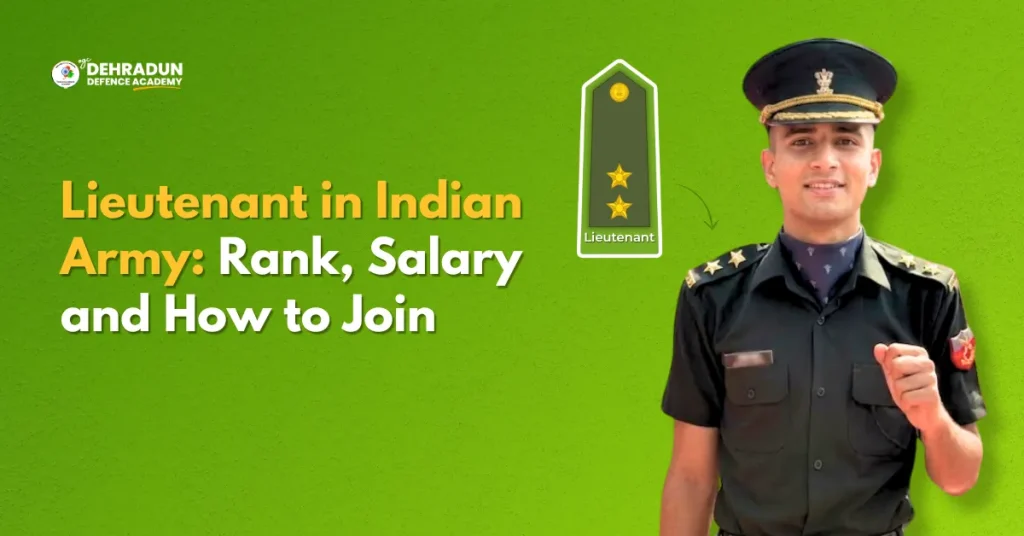
Lieutenant is the entry-level commissioned officer rank in the Indian Army. An officer normally receives this rank after successfully completing their pre-commissioning training at academies such as the Indian Military Academy (IMA) or Officers Training Academy (OTA)..
A Lieutenant is responsible for leading soldiers, maintaining discipline and carrying out the orders of senior officers. The exact duties depend on the officer’s arm, service, unit and appointment.
The rank carries both authority and responsibility. A newly commissioned Lieutenant may be young, but the officer is expected to lead trained soldiers in peace stations, field areas and operational environments.
What Is a Lieutenant in the Indian Army?
A Lieutenant is the junior-most regular commissioned officer rank in the Indian Army.
Candidates selected through different officer-entry schemes undergo pre-commission training. After successfully completing the required training, they are commissioned into the Indian Army in the rank of Lieutenant.
A Lieutenant may hold either:
- Permanent Commission
- Short Service Commission
The type of commission depends on the entry through which the officer joins the Army.
Read: where Lieutenant sits in the Indian Army’s officer rank structure
Is a Lieutenant a Commissioned Officer?
Yes. A Lieutenant is a commissioned officer.
A commissioned officer receives legal authority to command troops and perform military duties. The officer becomes part of the leadership structure of the Indian Army.
A Lieutenant should not be confused with a Junior Commissioned Officer.
Junior Commissioned Officers include ranks such as Naib Subedar, Subedar and Subedar Major. A Lieutenant belongs to the commissioned officer category.
Position of Lieutenant in Army Rank Structure
Lieutenant is the first rank in the regular commissioned officer hierarchy of the Indian Army.
The officer rank order is:
| Order | Indian Army Rank |
| 1 | Lieutenant |
| 2 | Captain |
| 3 | Major |
| 4 | Lieutenant Colonel |
| 5 | Colonel |
| 6 | Brigadier |
| 7 | Major General |
| 8 | Lieutenant General |
| 9 | General |
| 10 | Field Marshal |
A Lieutenant is immediately below a Captain in the commissioned officer rank structure.
Field Marshal is the highest rank in the Indian Army. However, it is a rare five-star rank and is not part of the normal promotion system.
Lieutenant Rank Insignia
The rank insignia of an Indian Army Lieutenant consists of two five-pointed stars.
The insignia is worn on the shoulder straps of the uniform. Other badges and symbols may also appear according to the officer’s regiment, corps, service and uniform type.
The insignia helps identify the officer’s rank within the military hierarchy.
Main Duties of a Lieutenant
A Lieutenant is expected to perform operational, administrative and leadership duties.
The exact role varies across Infantry, Armoured Corps, Artillery, Engineers, Signals, Army Air Defence, Army Service Corps and other arms and services.
The main responsibilities may include:
- Leading soldiers during training and operations
- Implementing the orders of senior officers
- Maintaining discipline within the unit
- Looking after the welfare of soldiers
- Supervising weapons, equipment and stores
- Planning and conducting military training
- Maintaining operational readiness
- Preparing reports and official records
- Managing personnel under the officer’s appointment
- Participating in field exercises and military operations
A Lieutenant must learn quickly and work closely with experienced Junior Commissioned Officers and Non-Commissioned Officers.
Command Responsibility of a Lieutenant
A Lieutenant may be appointed to lead a platoon, troop or another small military element. The name and size of the element depend on the arm or service.
For example, an Infantry officer may serve as a platoon commander. An officer in the Armoured Corps may receive responsibility connected with a troop. Officers in technical and support services may hold specialist or administrative appointments.
A Lieutenant works under senior officers such as the Company Commander, Squadron Commander, Battery Commander or another designated superior.
The appointment of every Lieutenant is not identical. It depends on the unit, service requirements, experience and operational situation.
Lieutenant Salary in the Indian Army
A Lieutenant is placed in Level 10 of the Defence Pay Matrix.
| Salary Component | Amount |
| Pay Level | Level 10 |
| Basic Pay Range | ₹56,100–₹1,77,500 per month |
| Starting Basic Pay | ₹56,100 per month |
| Military Service Pay | ₹15,500 per month |
The starting basic pay of a newly commissioned Lieutenant is normally fixed at the first cell of Pay Level 10.
Military Service Pay is paid separately at the rate prescribed for officers from Lieutenant to Brigadier.
Read: The full pay scale across every Army rank
Lieutenant Salary Structure
The broad salary structure can be understood as:
Total Salary = Basic Pay + Military Service Pay + Dearness Allowance + Other Admissible Allowances − Deductions
- The final monthly amount depends on several factors, including:
- Place of posting
- Type of accommodation
- Operational area
- Applicable allowances
- Income tax
- Government deductions
- Insurance and contribution-related deductions
An exact in-hand salary cannot be fixed for every Lieutenant because postings and individual conditions differ.
Allowances for an Army Lieutenant
A Lieutenant may receive different allowances according to government rules and the nature of duty.
These may include:
- Dearness Allowance
- Military Service Pay
- Transport Allowance
- Field Area Allowance
- High Altitude Allowance
- Risk and Hardship Allowance
- Flying Allowance, where applicable
- Special Forces Allowance, where applicable
- Uniform-related benefits
- Government accommodation or admissible housing benefits
- Travel-related benefits
- Medical facilities
- Leave Travel Concession as applicable
Every Lieutenant does not receive every allowance. An allowance is paid only when the officer meets its prescribed conditions.
Salary During Training
Selected officer cadets undergoing notified pre-commission training receive a fixed stipend according to the applicable entry rules.
Recent Indian Army recruitment notifications prescribe a stipend of ₹56,100 per month for eligible cadets during training.
After successful commissioning, the officer’s pay is fixed in the first cell of Level 10.
The training period is not automatically treated as commissioned service for every purpose. The rules mentioned in the relevant entry notification apply.
How to Become a Lieutenant in the Indian Army
There is no single direct examination called the “Lieutenant exam.”
A candidate must first qualify through an authorised officer-entry scheme. The candidate then undergoes SSB assessment, medical examination, merit-based selection and military training.
After successfully completing pre-commission training, the candidate is commissioned as a Lieutenant.
The main officer-entry routes include:
- National Defence Academy Entry
- Combined Defence Services Entry
- Technical Entry Scheme
- Technical Graduate Course
- Short Service Commission Technical Entry
- NCC Special Entry
- Judge Advocate General Entry
- In-service commissioning entries
- Territorial Army Officer Entry
Each entry has different conditions related to age, education, marital status and training.
NDA Entry
The National Defence Academy entry is available after Class 12.
Candidates apply for the NDA and Naval Academy Examination conducted by UPSC. The selection process includes:
- Written examination
- Services Selection Board assessment
- Medical examination
- Final merit list
Selected Army cadets undergo joint training at the National Defence Academy. They later receive further Army training at the Indian Military Academy.
After completing the prescribed training, they receive a Permanent Commission in the rank of Lieutenant.
CDS Entry
Graduates can join the Indian Army through the Combined Defence Services Examination conducted by UPSC.
- Candidates selected for the Indian Military Academy receive a Permanent Commission after completing training.
- Candidates selected for the Officers Training Academy receive a Short Service Commission after completing training.
Both routes lead to commissioning in the rank of Lieutenant.
Technical Entry Scheme
The Technical Entry Scheme is an officer-entry route for eligible Class 12 candidates with the prescribed science subjects and other qualifications.
Selection generally includes:
- Application screening
- SSB assessment
- Medical examination
- Merit list
Selected candidates undergo military and technical training. After successful completion of the prescribed course, they receive a Permanent Commission in the rank of Lieutenant.
The exact qualification, age and shortlisting conditions are given in the notification for each course.
Technical Graduate Course
The Technical Graduate Course is meant for eligible engineering graduates.
There is generally no UPSC written examination for this entry. Candidates are shortlisted according to the conditions mentioned in the official notification.
The main stages are:
- Shortlisting
- SSB assessment
- Medical examination
- Merit list
- Training at the designated academy
After successfully completing training, candidates receive a Permanent Commission as Lieutenant.
SSC Technical Entry
Engineering graduates may also apply through the Short Service Commission Technical Entry.
Candidates are shortlisted before appearing for the SSB. Those who qualify the SSB, medical examination and merit list undergo pre-commission training.
After completing training, they receive a Short Service Commission in the rank of Lieutenant.
NCC Special Entry
Eligible NCC candidates can apply through the NCC Special Entry Scheme.
The entry normally requires the prescribed graduation qualification and NCC certification. The exact grading, service and age conditions are announced in the relevant notification.
There is generally no separate written examination. Candidates are shortlisted for SSB assessment.
After selection and successful training at the Officers Training Academy, candidates are commissioned as Lieutenants under Short Service Commission.
Judge Advocate General Entry
Law graduates who satisfy the prescribed conditions can apply for the Judge Advocate General Branch.
The JAG Branch deals with military law, legal advice, disciplinary matters and court-related work within the Army.
Selection includes shortlisting, SSB assessment, medical examination and merit. After completing training, selected candidates are commissioned as Lieutenants.
In-Service Commissioning Entries
Serving Army personnel may become commissioned officers through authorised in-service entries.
These include schemes such as:
- Army Cadet College Entry
- Special Commissioned Officers Entry
- Permanent Commission Special List, where applicable
The eligibility conditions depend on service record, age, education, examinations and selection procedures.
Successful candidates undergo the prescribed training before receiving a commission.
Territorial Army Lieutenant
The Territorial Army is also part of the Indian Army. Eligible civilians and former service personnel may apply for officer entry under the conditions announced for Territorial Army recruitment.
Candidates selected as Territorial Army officers can be commissioned in the rank of Lieutenant.
A Territorial Army officer should not be confused with a regular full-time Army officer. Service conditions, embodiment and training requirements are governed by Territorial Army rules.
Selection Process
The exact selection process depends on the entry. However, the broad stages may include:
- Written examination or application shortlisting
- Services Selection Board assessment
- Medical examination
- Preparation of merit list
- Pre-commission training
- Final commissioning
Clearing the SSB does not guarantee selection. The candidate must also be medically fit and placed sufficiently high in the merit list according to available vacancies.
SSB Assessment
The Services Selection Board assesses whether a candidate has the qualities required to become an officer.
The assessment normally includes:
- Officer Intelligence Rating Tests
- Picture Perception and Discussion Test
- Psychological Tests
- Group Testing Officer Tasks
- Personal Interview
- Conference
Candidates are assessed for officer-like qualities, leadership potential, communication, teamwork, reasoning and trainability.
Training of a Lieutenant
A candidate does not become a Lieutenant immediately after passing a written examination or SSB.
The candidate must successfully complete the prescribed pre-commission training.
Major Army officer-training institutions include:
- Indian Military Academy, Dehradun
- Officers Training Academy, Chennai
- National Defence Academy, Khadakwasla, followed by further service training
Other technical and specialised training institutions, depending on the entry
Training covers military subjects, physical conditioning, weapons, tactics, field craft, leadership, discipline and service knowledge.The training period differs according to the entry.
Permanent Commission and Short Service Commission
A Lieutenant may hold a Permanent Commission or Short Service Commission.
Permanent Commission
A Permanent Commission allows an officer to continue in service until the applicable retirement age, subject to service rules.
Common Permanent Commission routes include NDA, IMA through CDS, TES and TGC.
Short Service Commission
A Short Service Commission allows an officer to serve for the period prescribed under the applicable rules.
Common SSC routes include OTA through CDS, NCC Special Entry, JAG Entry and SSC Technical Entry.
The terms may include options for extension or Permanent Commission consideration according to current government policy.
Promotion From Lieutenant to Captain
Lieutenant is the first commissioned rank. The next rank is Captain.
Under the normal promotion structure, an officer becomes eligible for the substantive rank of Captain after completing two years of reckonable commissioned service.
Promotion remains subject to applicable service rules and required conditions.
The broad time-based progression is:
| Rank | Reckonable Commissioned Service |
| Lieutenant | On commissioning |
| Captain | 2 years |
| Major | 6 years |
| Lieutenant Colonel | 13 years |
Higher promotions involve additional service requirements, professional qualifications, vacancies and selection criteria.
Read also: Officers who rose from Lieutenant to Army Chief
Lieutenant and Lieutenant General Are Different Ranks
Lieutenant and Lieutenant General are very different ranks.
| Basis | Lieutenant | Lieutenant General |
| Position | Entry commissioned rank | Senior general officer rank |
| Star Category | Junior officer rank | Three-star rank |
| Place in Hierarchy | Below Captain | Below General and above Major General |
| Typical Career Stage | Beginning of commissioned service | Senior stage of military career |
The word “Lieutenant” appears in both titles, but the ranks should not be confused.
Equivalent Ranks in Other Services
The broad equivalent of an Army Lieutenant in the other two Armed Forces is:
| Service | Equivalent Junior Officer Rank |
| Indian Army | Lieutenant |
| Indian Navy | Sub Lieutenant |
| Indian Air Force | Flying Officer |
Although these ranks are broadly equivalent, their uniforms, training, appointments and service responsibilities differ.
Can Women Become Lieutenants in the Indian Army?
Yes. Eligible women can become commissioned officers in the Indian Army through authorised entries.
Women candidates may apply through entries such as NDA, CDS-OTA, NCC Special Entry, SSC Technical and JAG, subject to the conditions of the relevant notification.
After successful selection and completion of training, they are commissioned in the rank of Lieutenant.
The availability of arms, services, vacancies and commission types is governed by current policy and individual recruitment notifications.
Frequently Asked Questions
What is a Lieutenant in the Indian Army?
A Lieutenant is the entry-level commissioned officer rank in the Indian Army. Officers normally receive this rank after successfully completing pre-commission training.
Is Lieutenant the lowest officer rank in the Indian Army?
Lieutenant is the junior-most regular commissioned officer rank in the present Indian Army officer structure.
What is the salary of an Army Lieutenant?
A Lieutenant is placed in Pay Level 10. The basic pay range is ₹56,100–₹1,77,500 per month. Military Service Pay of ₹15,500 per month is also admissible.
What is the in-hand salary of a Lieutenant?
There is no single fixed in-hand salary. It depends on posting, allowances, government accommodation, tax and deductions.
What is the rank insignia of a Lieutenant?
The Lieutenant rank insignia consists of two five-pointed stars.
Is a Lieutenant a JCO?
No. A Lieutenant is a commissioned officer. JCO ranks form a separate category.
How can I become a Lieutenant after Class 12?
Eligible candidates can apply through entries such as NDA or the Technical Entry Scheme, subject to the relevant notification.
How can I become a Lieutenant after graduation?
Graduates may apply through entries such as CDS, NCC Special Entry, JAG, TGC or SSC Technical, depending on their qualification.
Which academy trains Army Lieutenants?
Officer cadets may train at the Indian Military Academy, Officers Training Academy or other designated institutions depending on their entry.
Can women become Lieutenants?
Yes. Eligible women can join the Indian Army as commissioned officers through authorised officer-entry schemes.
What comes after Lieutenant?
Captain is the next commissioned rank after Lieutenant.
How long does it take to become a Captain?
Under the normal structure, an officer becomes eligible for the substantive rank of Captain after completing two years of reckonable commissioned service, subject to service conditions.
Is Lieutenant a Permanent Commission rank?
Lieutenant is a rank, not a type of commission. Both Permanent Commission and Short Service Commission officers may be commissioned as Lieutenants.